
Do Wheelchair Users Need a Chauffeur for Airport Transfers?
Book wheelchair airport transfers with ramp access and secure seating, then learn the exact questions to ask and steps to book with confidence.
Get an instant priceBook wheelchair airport transfers with ramp access and secure seating, then learn the exact questions to ask and steps to book with confidence.
Get an instant price← All articles · Published 26 October 2026 · 15 min read
Last Updated: October 26, 2026
Quick Summary
Wheelchair users do not need a chauffeur in the legal sense, but pre-booked wheelchair airport transfers are the reliable option because rank taxis are almost never accessible. Book an accessible vehicle with a ramp or lift, four-point securement and a trained driver, and confirm the vehicle, fare and meeting point in writing.
If you use a wheelchair, the gap between booked wheelchair airport transfers and a taxi hailed at the rank is not comfort, it is whether you get to the terminal at all.
An accessible airport transfer is not a taxi with extra space. It is a booking made in advance, in a specific vehicle, with a specific driver, at a fixed price.
A standard taxi rank works on whoever is next. That model fails wheelchair users because the next cab is almost never accessible, and the driver has no obligation to wait while you transfer.
Pre-booking flips the logic. If you want to understand how a provider guarantees punctuality, our guide to guaranteed on time airport chauffeur service explains the flight tracking and driver dispatch behind it.
The practical difference: a booked chauffeur is expecting you. A rank taxi is expecting a fare.
Surge pricing is the quiet tax on accessible travel. Demand spikes when a flight lands, fares climb, and the traveller with the largest vehicle requirement pays the most.
A fixed-price transfer removes that variable: you agree the fare at booking and it holds regardless of traffic or a delayed flight. You can read the key benefits of fixed price airport transfers Brisbane in more detail. Our guide on how to avoid surge pricing for airport rides sets out seven practical steps.
Genuine wheelchair airport transfers include four things: a purpose-built vehicle with a ramp or lift, a tested securement system, a trained driver, and door-to-door service.
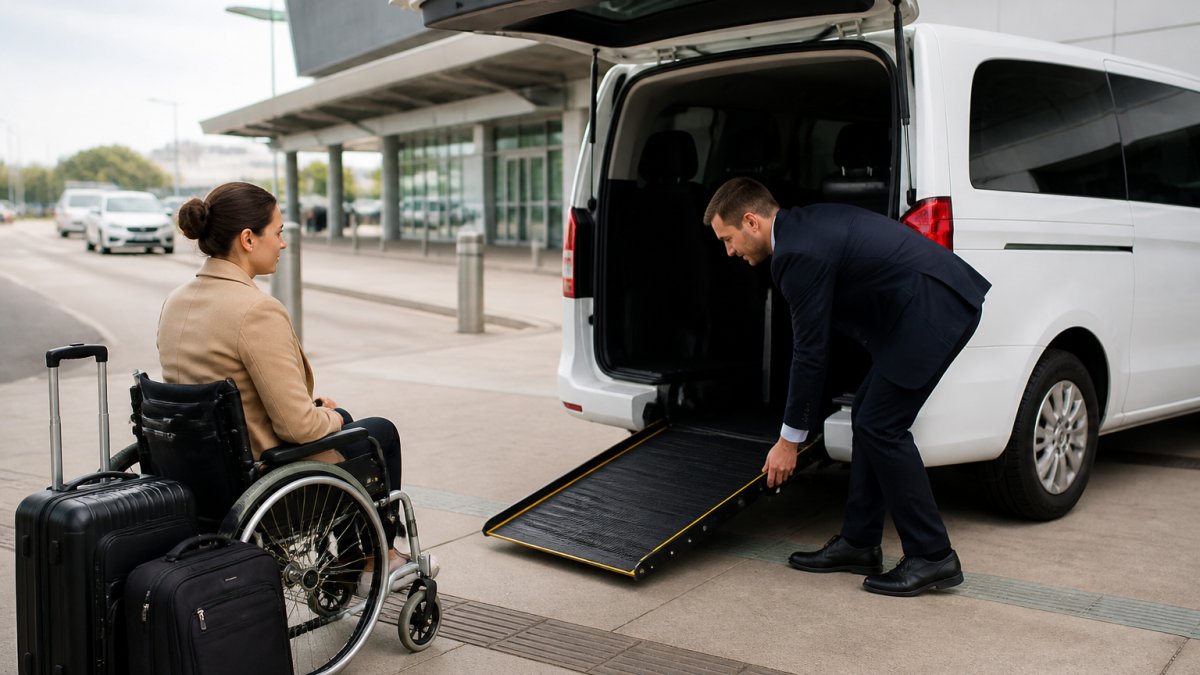
A wheelchair-accessible van is modified with a rear or side-entry ramp, or a mechanical lift where floor height demands it. A ramp suits manual wheelchairs and most powered chairs within weight limits; a lift handles heavier powered chairs.
Securement matters just as much. A proper system uses four-point straps anchored to the vehicle floor, plus a lap and shoulder belt routed around the passenger rather than the chair alone.
Most travellers prefer to stay in their own wheelchair for the journey, standard practice in an accessible vehicle, and it removes the transfer risk.
If you can transfer independently, a standard chauffeur vehicle may suit you, provided there is space for a folded manual wheelchair in the boot. Tell the provider which option you need at booking. The vehicle specification changes accordingly.
Airport wheelchair assistance and your chauffeur cover different legs of the same trip: the airport provides support from the terminal entrance to the gate, while your chauffeur covers the road journey and kerb handover.
The handover is where planning pays off. If you are unsure which terminal applies, read about Brisbane Airport domestic or international terminals.
Tell your chauffeur your flight number and whether you have requested airline assistance. A coordinated handover means you are met, not searched for.
A wheelchair transport booking checklist turns a hopeful phone call into a confirmed arrangement. Every item should produce an answer you could hold a provider to if the wrong vehicle arrives. Work through it before you pay a deposit, and keep the answers in writing. For a step-by-step walkthrough, see our guide on how to book reliable airport transfers.
These items separate a genuine accessible provider from one that simply owns a van with a ramp bolted on.
Ask directly and listen for specifics. Five questions separate a real accessible provider from a hopeful one:
If any answer is fuzzy, book elsewhere. This is the single most useful habit in accessible travel planning.
Book as early as your plans allow. Accessible vehicles are a smaller fleet than standard cars, so availability tightens around peak periods and school holidays.
For a routine airport run, a few days of lead time is sensible. For group bookings, cruise terminal pickups or travel during busy seasons, give more notice. If you need a vehicle at short notice, phone rather than booking online so the provider can check live availability against the specific vehicle your chair needs.
Luggage and wheelchair space compete for the same square metres in any accessible vehicle.
A side-entry ramp typically preserves more cabin space for passengers, while a rear-entry ramp uses the rear cargo area for boarding.
Tell the provider how many suitcases and carry-on bags you have and whether you travel with a mobility device such as a walker or hoist.
Here is the sequence we use, and the one we recommend with any provider.
Step 1: Gather your details. Flight number, arrival time, address, wheelchair type and dimensions, passenger and luggage counts.
Step 4: On the day, expect contact. A reliable provider tracks your flight and adjusts the pickup if you are delayed.
Step 7: Arrive door to door. You are dropped at your destination, not at the nearest accessible point.
Tell your chauffeur your flight number and whether you have requested airline assistance, so the handover is coordinated rather than improvised.
At pickup, the driver tracks the flight, positions the vehicle at the agreed accessible bay, deploys the ramp or lift, and waits while you board and are secured. At drop-off the reverse applies, the driver should know which terminal entrance has step-free access and a suitable kerb.
Delays are the most common failure point in an airport transfer, and the difference between a good and a bad provider is what happens next.
A few minutes of preparation covers the scenarios that derail accessible airport travel:
Here is the booking and pickup sequence the article recommends for accessible airport transfers.
| Step | What to do |
|---|---|
| 1 | Gather flight number, arrival time, address, wheelchair type and dimensions |
| 2 | Request an accessible vehicle with ramp or lift; state travel-in-chair or transfer |
| 3 | Confirm vehicle type, fare, meeting point and cancellation terms in writing |
| 4 | Expect driver contact; provider tracks flight and adjusts pickup if delayed |
| 5 | Meet at the agreed point with vehicle positioned for safe boarding |
| 6 | Driver secures wheelchair with four-point tie-downs and checks occupant belt |
| 7 | Arrive door to door, not at the nearest accessible point |
The challenge with accessible airport travel is not finding a vehicle. It is finding one that arrives when promised, at the price quoted, with the ramp and securement you were told to expect. Get that wrong and the whole trip starts badly.
Sky Transfers runs fixed-price chauffeur transfers with no surge fees, 24/7 availability, meet and greet with real-time flight tracking, and free cancellation up to 24 hours before pickup. We serve all Gold Coast and Brisbane suburbs and can coordinate larger groups. Tell us your wheelchair type and dimensions when you book so we assign the right vehicle.
Get started with Sky Transfers and arrive at the terminal on your own terms.
Yes, provided the vehicle is fitted with a four-point tie-down system and the operator confirms it at booking. Your wheelchair must be secured to the floor anchors and you should be restrained with a lap and shoulder belt, not just the chair's own belt. Confirm which option applies before you book.
Book at least seven days ahead for a standard airport run and two to three weeks for peak periods, early morning departures or group bookings. Accessible vehicles are a small share of most fleets, so availability tightens faster than it does for sedans. If your flight lands late at night or you need a specific vehicle type, give more notice. Confirming your booking and rechecking the pickup time 24 hours before travel catches most problems early.
A folded manual wheelchair takes roughly the space of a large suitcase, while a powered chair or one that stays occupied needs a dedicated bay with floor anchors. As a guide, allow one checked bag and one carry-on per passenger, plus room for mobility equipment. Tell the operator your chair's dimensions and weight, and how many bags you are bringing. If your group is larger than four, ask for a van with a rear loading area rather than a standard wagon.
Ask four things: whether the vehicle has a ramp or lift and its weight limit, whether you can stay in your chair during the trip, how many passengers and bags fit alongside the chair, and what the cancellation policy is. Also confirm whether the fare is fixed or metered, and whether flight delays are covered. A written booking confirmation listing these details protects you if plans change or the vehicle that arrives is not what you expected.
